
If somehow you didn’t know, I absolutely love Critical Role (this will not be the last time I’ll be writing about them, probably.) I love staying up late on Thursday nights watching this amazingly talented crew tell stories through Dungeons and Dragons.
My passion for this show is far beyond my fascination with D&D. It’s rare that you’re able to see such creative souls have such room to weave a beautiful tale both individually and collectively. Yes, it’s great to see a group of friends who just so happen to voice a lot of things I love dearly, but that kind of collective trust among friends really allows for breathtaking stories.
These storytellers have really inspired me to aim bigger with my creations and not to be afraid to create a complex character who helps me face my own battles. And ever since I first watched episode 1 of campaign 2, I’ve just become enlightened to the value of a good character.
When I first played D&D, Sharpo was one of the pre-rolled characters provided in the starter set for 5e. The first couple of sessions, it was really hard for me to get into it. I couldn’t understand why people were so in love with this game. It just seemed to be telling someone else’s story and I didn’t like that. So then, I really started paying attention to the way the CR cast were portraying their characters.
Yes, they were living in the world created by Matt, but they never lost their individual voices. They were able to add more color and detail to the world that was presented to them. Each character, both player and NPC, were different threads in this tapestry. Together, they made something great, and if you took a thread away, it changed your view.
So, I needed to create a reason why I cared about Sharpo beyond the fact that they were the character I was given. I needed to stop thinking of them as a tool to hammer myself into the story we were telling. I needed to treat this character like a paintbrush set, different brushes for different details.
I needed to stop trying to win. I needed to be a storyteller. I needed to create someone who had a purpose, goals, dreams, failures, etc. There had to be more than the printed out goal given to me on the character sheet. Just like I tell people, when creating a podcast or a story in any other capacity, I needed a reason to give a d@*n. If this story were to end abruptly, there should be enough satisfaction in what has been told, but also a desire for more.
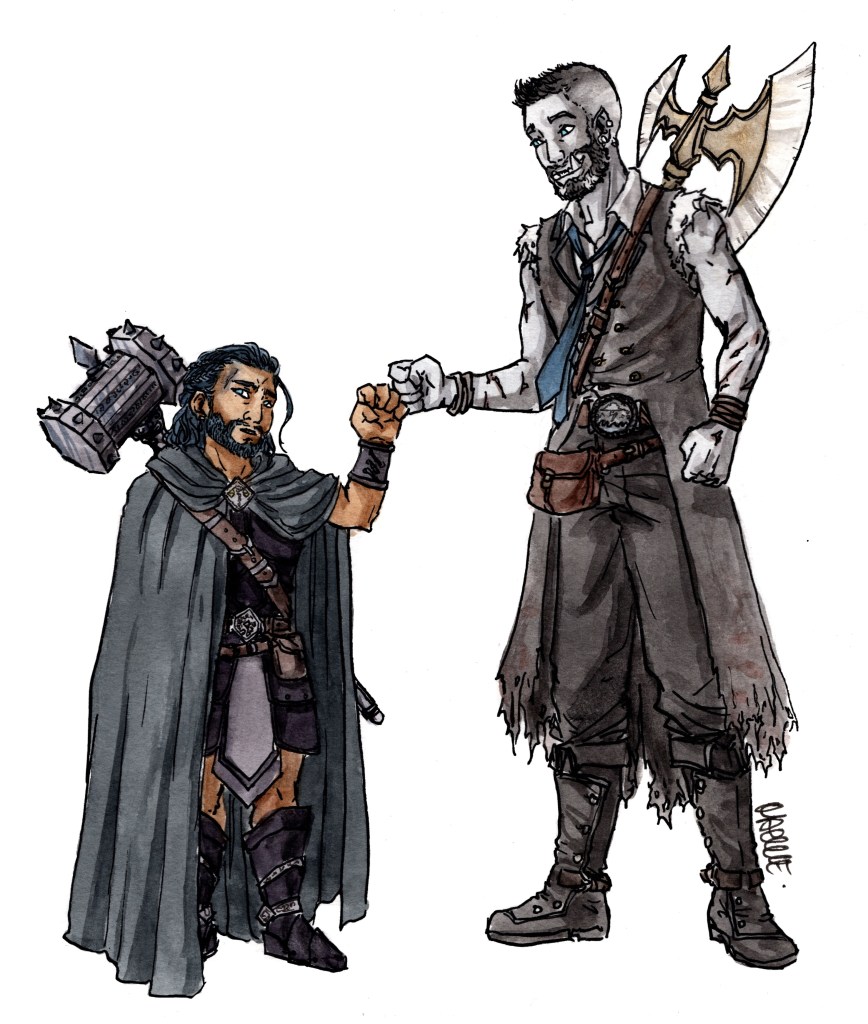
So I treated my character with care, and what do you know, I started feeling that love for my own D&D character that I feel towards the characters in Critical Role. By the time my first campaign wrapped up, I had created a complex character who I still love dearly. Even to this day, I miss being a cleric and am always ready to jump back into that dwarf’s shoes any time.
Sharpo and my current Barbladin Brute mean so much to me. I’ve created such big souls for these characters that if I lose them, it will hurt like hell.
Nothing hurts my soul more when people just expect the intense level of storytelling from the character they haven’t even begun to relate to or make their own.
Context and situations make all the difference in the world. Like Superman is one of the strongest heroes, but once you put Clark in a realm full of magic? He’s suddenly not the most powerful guy in the world.
There’s nothing wrong with using references and inspiration from other things you enjoy, but to completely expect someone else’s work and heart and expect the same result in different situations is foolish.
If things go poorly, they can blame everyone else. But if it’s successful, suddenly the ownership is all theirs. There’s a reason we can’t stand the Gilderoy Lockhart or Ernesto de la Cruz types in the world. What is the point of celebrating the unearned successes of people who didn’t work for it?
I could never do that intentionally. I try to give each character the best chance they deserve. They have a chance to tell a story, using some parts of my own soul that I’m not comfortable with confronting.
I’ll probably never end up on something like Critical Role, but if you’re reading this, I just ask that you open yourself up to beautiful, difficult stories because you might learn something about yourself someday.
 Irregular Spud